What the letters and numbers mean
A graphite pencil’s grade describes where it sits on a scale from harder, lighter-marking leads to softer, darker-marking ones. Pencils marked H are on the hard side; pencils marked B are on the soft side. HB sits near the middle, while F is another firm grade often used for fine lines. The number tells you how far a pencil lies from the middle: 4H is harder than 2H, and 6B is softer than 2B.
The “lead” in a graphite pencil does not contain lead metal. Its core is made primarily from graphite and clay. Broadly, a harder core contains more clay and tends to leave less graphite on the page; a softer core deposits graphite more readily. Grades are useful guides, but they are not exact measurements shared by every manufacturer. Two pencils labeled 2B may feel and look slightly different, so test a new pencil on the paper you plan to use.
How hard and soft pencils behave
Hard pencils keep a point longer and produce relatively pale, controlled marks. They suit light guidelines, precise contours and small details where a dark line would be distracting. Their limitation is that pressing harder does not always make them much darker. On some papers, heavy pressure from a hard point can indent or polish the surface, making later shading uneven or difficult to erase.
Soft pencils make darker marks with less pressure. They are useful for broad shading, expressive lines and the deepest accents in a drawing. Because they wear down faster, their lines can widen as you work; they may also smudge more easily. Very soft graphite can become shiny where it is built up heavily, especially on smooth paper. For rich darks, try layering with moderate pressure before bearing down.
Choosing grades for the drawing you want to make
You do not need every grade in the range. For a versatile starting set, try an H or 2H for faint planning lines, an HB or 2B for most drawing, and a 4B or 6B for darker tones. If you prefer a loose, tonal style, you may spend most of your time with B grades. If you draw intricate architecture or carefully measured forms, a harder pencil may be more useful at the beginning.
Choose by the mark rather than by a rule about what each grade must do. A sharp 2B can draw a fine line, while the side of an HB point can shade a larger area. Pressure, point shape and paper texture all change the result. A toothy paper catches more graphite and may make marks look darker or grainier; a smooth paper often gives cleaner lines but may offer less room to build up tone. Test combinations in a margin or on a spare sheet before committing to a detailed drawing.
Building tone without fighting the paper
Start lightly and establish the main shapes and value relationships before adding the darkest marks. An HB or 2B can cover much of the middle range. Switch to a softer pencil when you need a darker accent, rather than forcing a hard pencil into the paper. Leaving the lightest areas largely untouched often gives you a clearer highlight than trying to erase a heavily worked patch.
Keep a scrap sheet under your drawing hand to reduce accidental smears, and lift it rather than sliding it across the surface. A kneaded eraser can gently pick up graphite to lighten a passage or soften an edge. It may not fully remove a groove made by heavy pressure, which is another reason to make early lines lightly. Sharpening matters too: a long point helps with fine marks, while a blunter tip or the side of the core can make softer, broader strokes.
A quick exercise to find your preferences
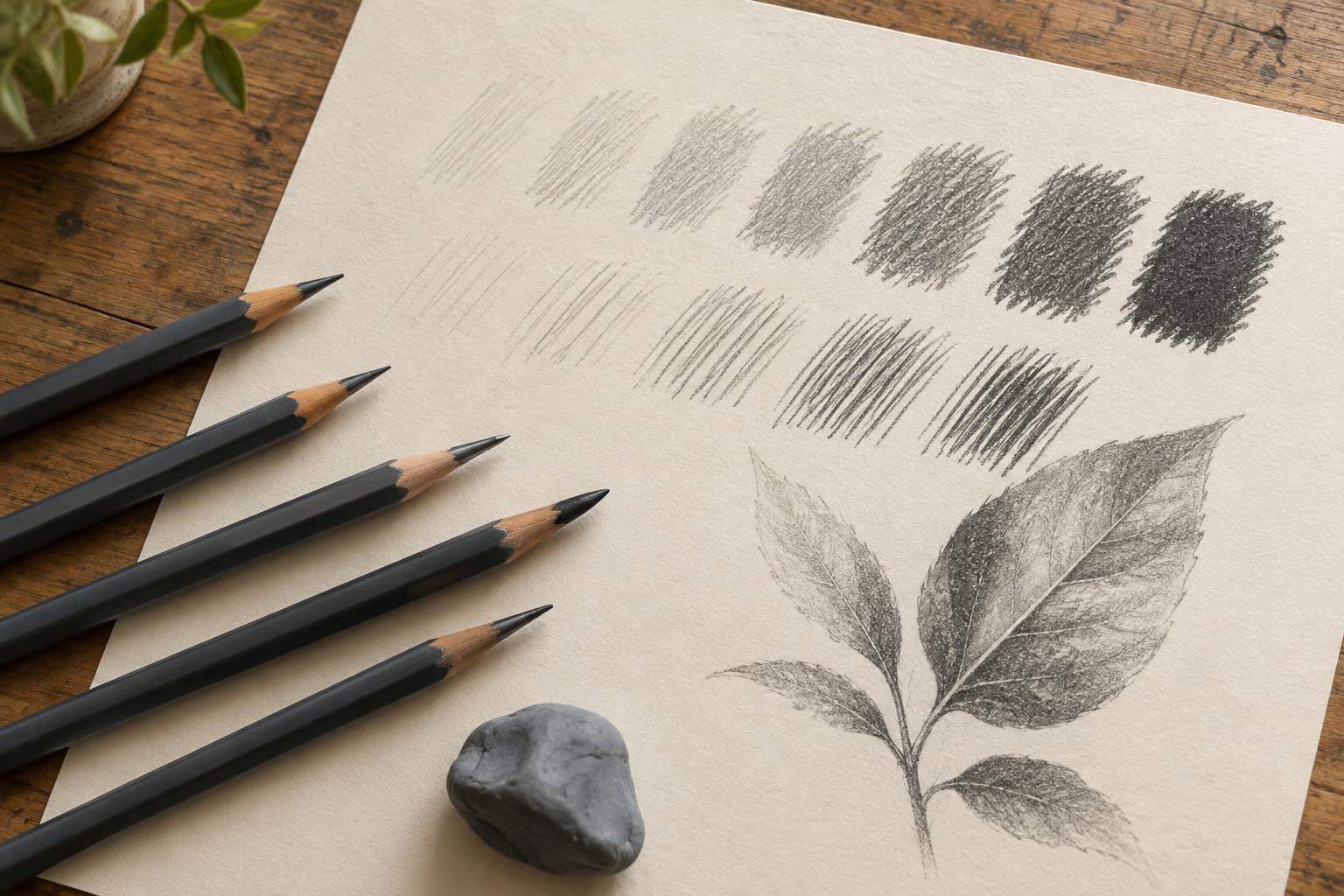
On the same kind of paper you use for drawing, make a small test strip for each pencil. Draw a line with light pressure, another with comfortable pressure, and a third as dark as you can make it without digging into the sheet. Then create a short gradient from pale to dark. Notice when the pencil starts to smudge, how long its point lasts and whether the darkest area turns glossy.
This simple comparison shows what your particular pencils can do more clearly than their labels alone. Keep the test page as a reference. Over time, you may find that two or three familiar grades cover nearly everything you need, with additional pencils serving a particular texture, scale or drawing style.