What fixative can—and cannot—do
A drawing fixative is a coating intended to reduce the movement of loose material such as charcoal, pastel, or graphite. It can make a surface less vulnerable to an accidental touch and may help keep one layer from mixing with the next. It does not make a drawing impossible to smudge, waterproof, or safe to handle without care. Its effect depends on the spray, the drawing material, the paper, and how much is applied.
Fixative can also alter the work it protects. A sprayed passage may look darker, less powdery, or slightly different in color or sheen. Delicate marks may become less distinct if they receive too much spray. Before using a product on an important drawing, try it on a scrap made with the same paper and media. Let the test dry fully, then view it under the light in which you normally assess your work.
Workable and final fixatives serve different purposes
Workable fixative is intended for use while a drawing is still in progress. A light application may hold a loose layer enough for you to add marks over it. For example, an artist might fix an early charcoal layer before developing darker passages. The treated surface may feel different under a pencil, stick, or brush, so test whether it still accepts the marks you want to make. “Workable” does not mean that every medium will layer easily over every sprayed surface.
Final fixative is intended for a drawing that is finished. It is generally chosen to reduce smudging during careful handling, storage, or framing rather than to support further drawing. The distinction is useful, but product names alone do not tell you how a spray will behave. Read the label for suitable media and surfaces, drying guidance, and any instructions about layering. Some drawings need no fixative at all, particularly if a test shows an unacceptable visual change.
Prepare the drawing and the spraying area
Check that the drawing is dry and that its surface is free of unwanted dust or debris. Remove loose particles gently without rubbing the marks you mean to keep. Set the work on a clean support and protect the surrounding area from overspray. If the paper has curled, secure it in a way that will not damage its edges or place adhesive over the image.
Follow the product label’s instructions for ventilation, spraying distance, temperature, and drying time. Avoid breathing spray mist, and keep aerosol products away from flames, heat, and other ignition sources. Wind can push spray unevenly across a drawing, while an unsuitable enclosed space can allow fumes to build up. Choose a location where you can follow the label safely and leave the work undisturbed as it dries.
Apply light, even coats
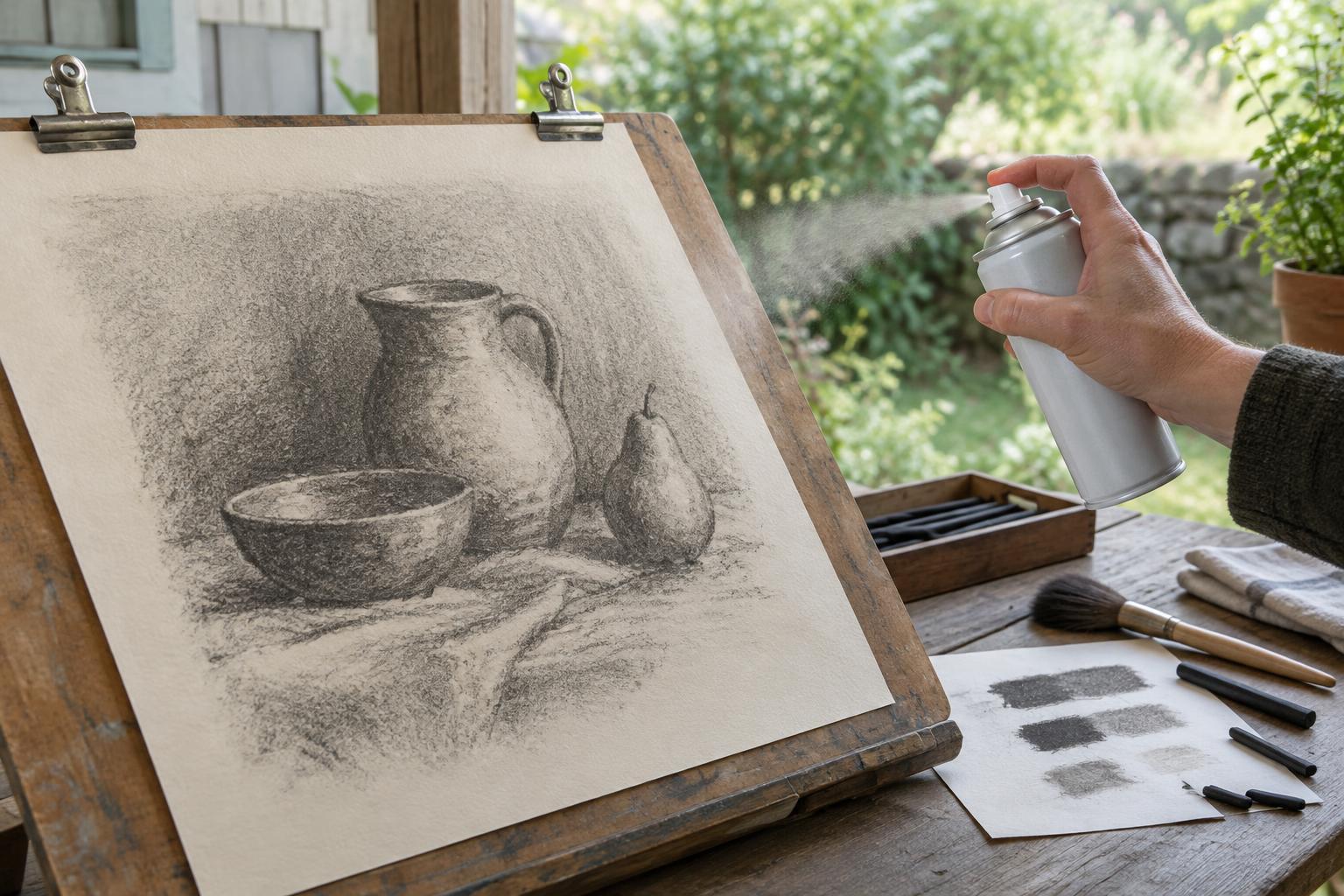
The aim is usually a light, even application rather than a visibly wet surface. Follow the label for shaking the can and holding it at the recommended distance. Begin spraying off the edge of the paper, move steadily across the drawing, and release the nozzle after passing the opposite edge. Slightly overlap each pass instead of pausing over one area. This helps avoid concentrated spots that may darken or disturb the media.
If the drawing needs another coat, allow the first to dry as directed before reassessing it. A second light pass may produce a more even result than one heavy pass, but more spray is not automatically better. Inspect the drawing without touching its surface. Once you are satisfied, give it the full recommended drying time before moving, stacking, or framing it.
Common mistakes to avoid
The most consequential mistake is skipping the test. Two sheets that look similar can absorb spray differently, and a fixative that suits graphite may change a soft pastel passage in a way you dislike. Test the complete combination of paper, drawing media, and fixative—not just the spray on blank paper. Also avoid substituting a product such as hairspray: it is not designed or labeled as a drawing fixative, and its long-term effects on artwork may be uncertain.
Other frequent problems come from spraying too close, lingering in one spot, or handling the sheet before it has dried. These can produce uneven coverage, visible droplets, or new smudges. Finally, do not treat fixative as a substitute for careful storage. Interleaving with suitable protective material, using a rigid support when moving a sheet, and framing with the drawing separated from the glazing can still matter after spraying. Fixative is one tool for managing a fragile surface, not a guarantee of permanence.